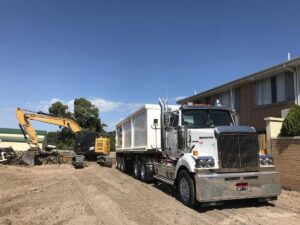
Did you know that as of July 2026, the Victorian metropolitan waste levy has risen to $177.19 per tonne? For any developer or business owner, this figure turns a standard commercial demolition melbourne project into a high-stakes balancing act where every kilogram of debris impacts your bottom line. It’s completely normal to feel a bit rattled by the sheer volume of red tape, from the 15-day council response windows for Section 29A applications to the rigorous electronic tracking now required by the EPA.
We know you’re looking for more than just a knockdown; you need a clean, level site that’s ready for its next chapter without any lingering legal or safety risks. This professional reference guide will help you master the complexities of site clearing by outlining the latest Victorian regulations, hazardous material safety, and efficient site preparation. We’ll show you how to manage the transition from an old structure to a build-ready foundation while ensuring your project stays on the right side of WorkSafe and local council rules.
Key Takeaways
- Learn how the Victorian Building Act 1993 and the VBA shape your compliance requirements to avoid project delays.
- Identify critical structural risks and hazardous materials common in Melbourne’s brick and steel commercial buildings before work begins.
- Compare mechanical bulk clearing with selective deconstruction to find the most efficient commercial demolition melbourne approach for your budget.
- Follow a methodical step-by-step process for site preparation, including safety hoardings and essential service disconnections.
- Discover the benefits of an end-to-end partnership that manages everything from the initial knockdown to the final site levelling.
Navigating Commercial Demolition in Melbourne’s Regulatory Landscape
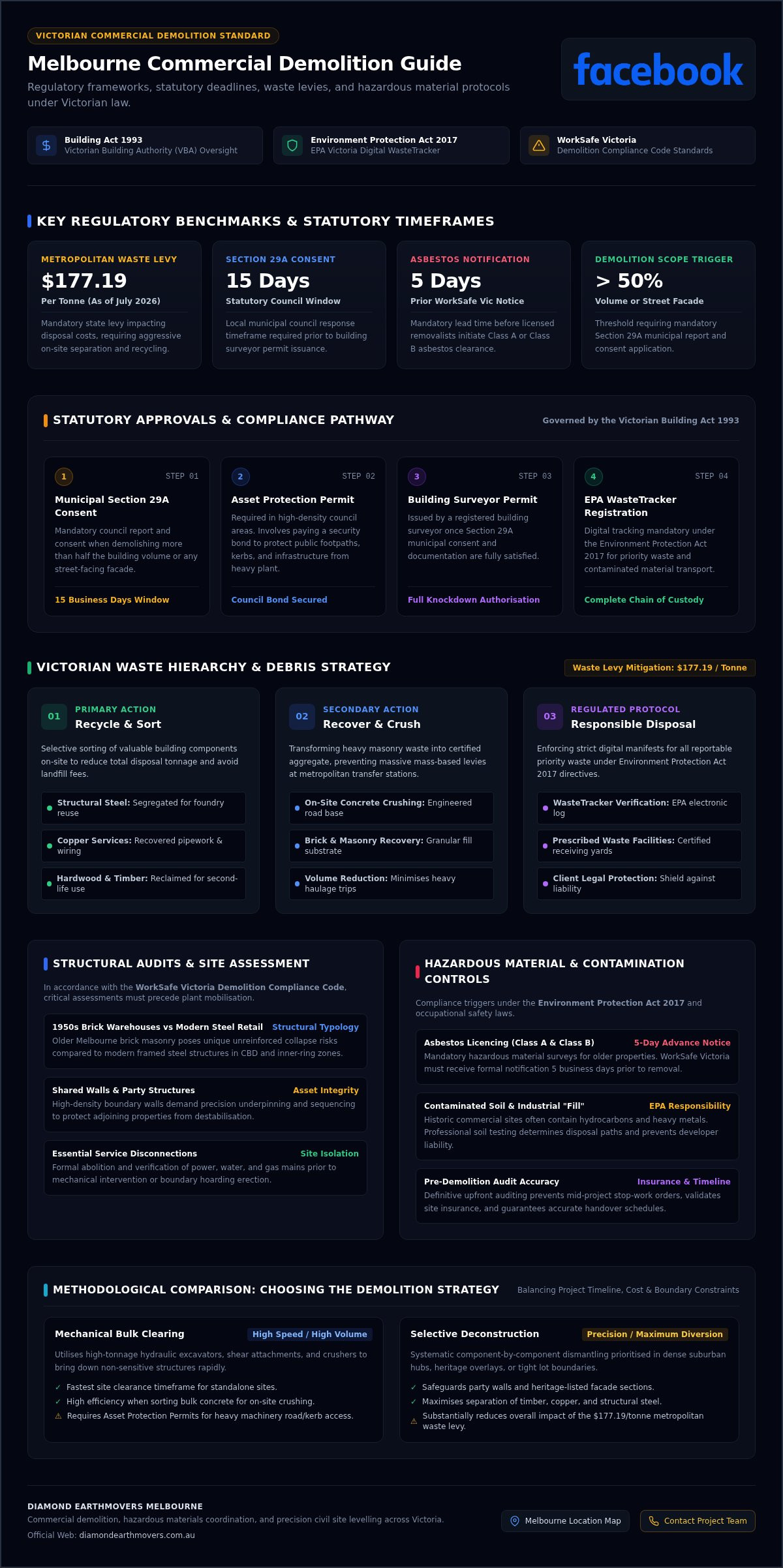
Managing a successful project in Victoria starts with a deep dive into the Victorian Building Act 1993. This legislation dictates every move we make on-site. The Victorian Building Authority (VBA) acts as the primary watchdog, ensuring that every commercial demolition melbourne firm operates with high levels of precision and safety. One of the most critical steps is obtaining Section 29A report and consent from your local municipal council. This is mandatory if you’re demolishing more than half the building’s volume or any part of a street-facing facade. Councils typically have a 15-business-day statutory window to respond, so we always recommend factoring this into your early timeline.
Local expertise is vital because Melbourne’s suburbs are a patchwork of different heritage overlays and site constraints. A project in Richmond might face completely different noise and access restrictions than one in Dandenong. We understand these nuances because we live and work here. If you need to discuss how these rules apply to your specific site, you can reach out to us at our contact page to start the conversation.
Victorian Building Regulations and Local Council Permits
Don’t confuse a general building permit with the specific approvals needed for demolition. While a registered building surveyor issues the final permit, they can’t do so until the local council provides Section 29A consent. In high-density areas, you’ll also need an Asset Protection Permit. This requires a security bond to ensure that heavy machinery doesn’t damage council footpaths or kerbs. Understanding various building demolition methods is essential here, as your chosen technique must align with council safety expectations and the 2026 Victorian worksite standards.
EPA Victoria Guidelines and Waste Management
The Environment Protection Act 2017 has made waste management a primary focus for any site clearing. Current metropolitan waste levy rates of $177.19 per tonne mean that sending everything to landfill is no longer a viable financial option. We strictly follow the Victorian waste hierarchy:
- Recycle: Sorting steel, copper, and timber for reuse.
- Recover: Crushing concrete and brick on-site for future road base.
- Responsible Disposal: Using the EPA’s WasteTracker tool for any reportable priority waste.
This digital tracking ensures a transparent chain of custody for every load of rubble or soil that leaves your site. It protects you from liability and ensures the project meets environmental obligations. If you’re coordinating a project and want to see where we operate from, you can view our Melbourne location to better understand our service reach across the state.
Structural Assessments and Hazardous Material Management
Before any excavators arrive on-site, a thorough structural audit is the first step in ensuring a safe commercial demolition melbourne project. Every building has its own story; a 1950s brick warehouse in Richmond presents different challenges compared to a modern steel-framed retail space in the CBD. We look for structural weaknesses, load-bearing walls, and potential hazards that could impact the public or adjacent buildings. This isn’t just about the knockdown. It’s about protecting shared walls and council assets. We strictly follow the WorkSafe Victoria Demolition Compliance Code to map out every risk before the first piece of machinery is even unloaded.
Identifying Asbestos and Contaminated Soil
Many older Melbourne commercial sites sit on land with a long industrial history. This often means dealing with “fill” or soil that contains contaminants like heavy metals or hydrocarbons. Under the Environment Protection Act 2017, you’re responsible for where this soil ends up. Professional soil testing is the only way to prevent future legal headaches. Then there’s the issue of asbestos. For buildings of a certain age, a hazardous material survey is a legal necessity. We coordinate with licensed removalists to handle Class A or Class B asbestos safely. Remember, WorkSafe Victoria must be notified at least 5 business days before any licensed asbestos removal begins. This keeps your site compliant and ensures your neighbours remain safe throughout the process.
Pre-Demolition Reports: Why Accuracy Matters
Accuracy in the early stages saves thousands in the long run. A detailed report ensures your insurance coverage is valid and your project timelines are realistic. It also forms the basis for an honest, transparent quote. We recommend reviewing our pre-demolition report checklist to see exactly what needs to be documented. This includes everything from service disconnections to vibration monitoring plans for nearby properties. A thorough report removes the guesswork, allowing us to plan for every contingency.
If you’re unsure about the history of your site or need a professional eye to assess the structure, reach out to the Diamond family team. Based at our Melbourne location, we’ve spent years helping clients navigate these early hurdles to ensure their site clearing stays on track and on budget.
Comparing Commercial Demolition Approaches: Precision vs. Bulk
Choosing the right method for your commercial demolition melbourne project depends entirely on your site’s constraints and your future building plans. While bulk mechanical demolition is often the quickest way to clear a standalone warehouse, it isn’t always the smartest choice for high-density urban corridors. Selective deconstruction, or “strip-outs,” allows us to salvage high-value materials like structural steel and timber. This approach is becoming increasingly popular as developers look to offset rising landfill costs. For multi-storey structures, we utilise high-reach excavators that allow for a top-down dismantling process, ensuring debris stays within the site boundaries and doesn’t threaten neighbouring footpaths or assets.
Safety remains the cornerstone of every approach we take. We operate in strict alignment with the Safe Work Australia code of practice for demolition work, which provides the framework for managing structural integrity and establishing robust Safe Work Method Statements (SWMS). Whether we’re using a precision “muncher” attachment to quietly break down concrete or a large-scale hammer, the goal is always to minimise vibration and noise for the surrounding Melbourne community. For sites with significant concrete slabs, footings, or reinforced structures, our approach to concrete demolition in Melbourne ensures every element is broken down safely and efficiently before site preparation begins.
Specialist Earthmoving: Site Levelling and Grader Hire
A successful project doesn’t end when the last truck of rubble leaves the site. The real value of a professional team is the ability to transition immediately into site preparation. This is where specialized earthmoving becomes vital. By performing precision site cuts and integrating drainage solutions during the clearing phase, we ensure the ground is stable and ready for the next trade to start. If you’re managing a large-scale commercial footprint, our professional grader hire in Melbourne is the most efficient way to achieve a perfectly level finish. We also specialise in constructing rock retaining walls, which are often necessary for sites with Victorian soil variations or sloping terrain.
Equipment Selection for Commercial Projects
The machinery on a site is only as good as the person behind the controls. For complex commercial jobs, we always recommend a wet hire arrangement. This ensures you get modern, well-maintained equipment operated by a specialist who understands the nuances of the commercial demolition melbourne landscape. Skilled operators can identify underground services or structural shifts that a less experienced eye might miss. Our family team takes immense pride in our fleet, ensuring every excavator and grader is up to the task. If you’d like to see where we coordinate our fleet and operations, you can find our Melbourne location here.
The Step-by-Step Commercial Demolition Process
A successful commercial demolition melbourne project is a choreographed sequence of events that prioritises safety and site readiness. We start by securing the perimeter with high-quality public safety hoardings and clearly defined site boundaries. This isn’t just about keeping people out; it’s about protecting the surrounding urban environment from the very first day. Once the site is secure, we move into the systematic disconnection of services. This involves working closely with utility providers to ensure electricity, water, gas, and telecommunications are legally and safely capped off before structural work begins.
Site Preparation and Service Disconnection
Coordination is the secret to a smooth start. We manage the dialogue with utility companies to prevent any accidental damage to mains or shared infrastructure. This phase also includes protecting existing trees and underground assets that are staying on the property. While this process shares some DNA with residential demolition in Melbourne, the scale is much larger. Commercial sites often have high-voltage lines or industrial-grade gas connections that require a more rigorous validation process before we can proceed.
Controlled Demolition and Material Salvage
Once the site is “cold,” we employ a top-down demolition method. This controlled approach maintains the structural integrity of the remaining building until each level is safely removed. It’s a precise way to manage the site that significantly reduces the risk of unplanned collapses. During this stage, our team focuses on separating materials at the source. By sorting concrete, steel, and timber as we go, we maximise recycling and keep your disposal costs lower. We also use dust suppression systems and acoustic curtains to minimise noise and vibration impacts on the local community.
The final stage involves clearing the remaining rubble and focusing on what lies beneath. We don’t just leave a hole in the ground. We provide professional backfilling and compaction to ensure you have a stable, build-ready surface. This methodical finish is what sets a professional site clearing apart from a standard knockdown. If you’re ready to plan your next project, our team is here to help.
You can also visit our Melbourne location to discuss your site preparation needs in person.
Partnering with Diamond Earthmovers for Your Commercial Project
Choosing a partner for your commercial demolition melbourne project is about more than just finding the biggest fleet. It’s about finding real accountability. We’ve all seen large-scale projects get lost in the shuffle of a corporate hierarchy, where the person you talk to in the office isn’t the one operating the machinery. At Diamond Earthmovers, we operate differently. We’re a family-owned team that puts our name on every job. This means when you’re dealing with complex site constraints or tight Victorian deadlines, you aren’t just another file number. You’re a partner in a process where we’re deeply invested in the final outcome.
The Advantage of a Family-Owned Melbourne Specialist
When you work with us, you get direct access to Steve, Jayden, and Claire. This direct line of communication is vital for commercial projects where site conditions can change overnight. We don’t believe in passing the buck; if a challenge arises with a council permit or a specific soil type, we handle it personally. Our family has spent decades navigating the unique terrain of Victoria, from the heavy clays of the northern suburbs to the sandy loams of the south. This local experience allows us to anticipate issues before they become costly delays. We take immense pride in our workmanship, ensuring that every site clearing is performed with the precision and safety our clients expect from a local leader.
Comprehensive Earthworks from Demolition to Site Ready
The biggest hurdle for many developers is managing multiple contractors for different phases of site preparation. One team handles the knockdown, another does the excavation, and a third is called in for the final levelling. We’ve designed our service to remove that friction. By offering a true end-to-end solution, we transition seamlessly from the initial demolition to specialized earthmoving tasks. This includes:
- Precision site cuts and bulk excavation for new foundations.
- Constructing durable driveways and heavy-duty access roads for construction traffic.
- Building engineered rock retaining walls to manage site levels and drainage.
- Utilising our specialized grader hire to achieve a perfectly level, build-ready finish.
Using a single contractor for the entire clearing and preparation phase reduces project complexity and ensures a higher standard of site hygiene. You won’t have to worry about one team leaving a mess for the next to clean up. We serve all of Melbourne and regional Victoria, bringing the same level of family-run reliability to every corner of the state. If you’re ready to start your next project with a team that values personal accountability as much as you do, we’re here to help.
We’re ready to help you clear the way for your next commercial venture with safety and precision as our top priorities. Reach out to Steve, Jayden, and Claire to discuss your site requirements today.
Frequently Asked Questions
Do I need a specific permit for commercial demolition in Melbourne?
Yes, you require Section 29A report and consent from your local municipal council before a building permit for demolition can be issued. This is a mandatory planning filter under the Victorian Building Act 1993. Councils generally have a 15-business-day window to respond to these applications. We work closely with registered building surveyors to ensure all documentation is in order before any machinery arrives on your site.
How much does commercial demolition cost per square metre in Victoria?
The cost of a project depends on several variables, including the building’s structural material, height, and the presence of hazardous substances like asbestos. Factors such as the proximity to neighbouring structures and the complexity of service disconnections also influence the final price. Because every site has unique constraints and waste management requirements, we provide tailored assessments to ensure your quote is accurate and reflects all necessary safety protocols.
What is the difference between commercial and residential demolition?
The primary differences involve the scale of the machinery, regulatory oversight, and site complexity. A commercial demolition melbourne project often requires high-reach excavators and stricter adherence to the WorkSafe Victoria Demolition Compliance Code. While residential jobs are often straightforward knockdowns, commercial sites frequently involve multi-storey structures, complex utility capping, and detailed EPA waste tracking. The environmental auditing requirements for commercial land are also significantly more rigorous than for standard housing lots.
How long does a typical commercial site clearing project take?
A typical project can take anywhere from a few weeks to several months depending on the size of the structure and the required permits. Timelines are influenced by the 15-day council review period and the mandatory 5-day WorkSafe notification window for licensed demolition or asbestos removal. We focus on a methodical pace to ensure every safety protocol is met, including the final site preparation and levelling phases which make the land build-ready.
Can you manage asbestos removal as part of the demolition?
Yes, we coordinate licensed asbestos removal as a fundamental part of our site clearing services. Whether your building contains friable Class A materials or non-friable Class B sheets, it must be handled by registered specialists. We ensure all removals are notified to WorkSafe Victoria at least 5 business days before work begins. Every load is tracked through the EPA WasteTracker tool to provide a digital chain of custody for all hazardous waste.
Do you provide site levelling and grading after the demolition is finished?
We certainly do, as site preparation is a core part of our end-to-end service offering. Unlike many contractors who leave once the building is down, we use our own precision grader hire and excavation equipment to finish the job. We can perform site cuts, build rock retaining walls, and construct access roads or driveways. This ensures your land is completely stable and ready for the next phase of construction to begin. For sites requiring specialized structural support, A1 Precision Solutions offers concrete slab underpinning and levelling to guarantee a secure foundation.
Waste is managed through a strict hierarchy of recycling, recovery, and responsible disposal to minimise landfill impact. Concrete and brick are often crushed for use as road base, while structural steel and timber are salvaged for recycling. For any reportable priority waste, we use the EPA Victoria electronic WasteTracker. This ensures full compliance with environmental laws and helps manage the impact of the metropolitan waste levy, which is $177.19 per tonne.
How do you protect neighbouring buildings during a commercial teardown?
We use a combination of physical barriers and technical monitoring to protect adjacent properties during commercial demolition melbourne. This includes installing public safety hoardings and using acoustic curtains to dampen noise and dust. In high-density areas, we often set up vibration sensors and conduct detailed pre-demolition structural assessments of shared walls. By using precision attachments like hydraulic munchers instead of bulk hammers, we significantly reduce the risk of structural stress to neighbouring assets. For projects involving reinforced slabs or concrete footings, our expertise in professional concrete demolition in Melbourne ensures these elements are removed with minimal impact on surrounding structures.