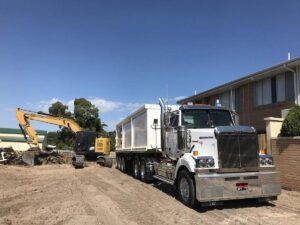
Anyone with a credit card can hire an excavator for the weekend, but having access to heavy machinery doesn’t make someone an earthmover. When you set out to hire excavating contractors in Melbourne, the true test of quality comes down to operator precision, underground service protection, and site safety, not just the size of the bucket.
Every property owner shares the same worry: the sudden disaster of a sliced utility line, cracked drainage, or surprise quote variations for rock excavation and spoil disposal that blow out your budget. Telling the difference between a seasoned trade professional and an inexperienced operator with rented gear shouldn’t be a guessing game. Discover how to evaluate, vet, and choose professional excavating contractors across Victoria with this complete hiring checklist.
We’ll walk you through verifying essential Victorian licences and insurances, assessing true machine capability, and securing clear, fixed-scope quotes to ensure your earthmoving project finishes safely, smoothly, and on time.
Key Takeaways
- Define your project scope precisely from the outset to avoid unexpected delays and establish clear site preparation benchmarks.
- Learn how to vet professional excavating contractors across Victoria by verifying WorkSafe compliance, utility asset location, and adequate public liability insurance.
- Understand the distinct value of wet hire machinery, where seasoned operators ensure precision grading and active protection of underground services.
- Identify critical inclusions for fixed-scope contracts, ensuring rock excavation contingencies and spoil disposal costs are transparently detailed before work begins.
- Recognise common industry red flags and quote discrepancies to choose an accountable earthmoving partner committed to quality workmanship.
What Do Excavation Contractors Do? Defining Your Scope
Professional earthmoving involves much more than simply shifting dirt from one spot to another. At its core, the work of certified earthworks in civil engineering establishes the structural integrity, drainage paths, and overall safety for any subsequent construction. Across Melbourne, seasoned excavating contractors prepare land for residential dwellings, commercial developments, and expansive rural properties. Clearly outlining your exact scope early ensures you engage the right machinery fleet and operator expertise from day one.
A standard earthmoving scope covers several critical tasks:
- Vegetation and site clearing: Stripping organic topsoil, tree stumps, and debris to reach stable bearing ground.
- Foundation cutting and benching: Carving precise building pads and footing trenches aligned with engineering drawings.
- Trenching for infrastructure: Excavating accurate utility runs for storm water, sewer, electrical, and water connections.
- Establishing design levels: Laser-grading levels to direct surface run-off away from structural foundations.
Residential Site Cuts and Foundation Preparation
Residential site cuts demand pinpoint accuracy. Operators cut into natural slopes and compact fill benches to create flat, engineered building platforms. Melbourne’s notorious reactive clay soils expand and contract with seasonal moisture shifts, meaning improper subgrade compaction quickly leads to slab heave or structural cracking. Experienced excavating contractors calculate cut-and-fill volumes carefully. By balancing soil on site, they preserve subgrade stability while eliminating the substantial expense of transporting excess spoil offsite.
Specialised Rural and Civil Earthworks
Beyond urban building pads, complex projects require advanced civil techniques. Water storage dams need careful clay core extraction, systematic layer compaction, and engineered overflow spillways to prevent wall blowouts. Similarly, building equestrian arenas requires multi-layered aggregate sub-bases topped with laser-graded falls for instant drainage. For rural access roads and driveways, operators rely on heavy grader hire to crown the surface, compact sub-base rock, and carve swale drains that survive torrential Victorian downpours.
Victorian Compliance Checklist: Licences, Insurance, and Safety Standards
Operating heavy machinery on private or commercial property carries significant legal and physical responsibility. In Victoria, state bodies govern earthmoving works through rigorous workplace safety legislation and environmental protection frameworks. Skipping thorough credential checks leaves landholders open to severe financial penalties and liability if an accident occurs on their boundary. Reliable excavating contractors will always present active certificates of currency and safety documentation before walking their machines onto your soil.
Before agreeing to ground disturbance, confirm these regulatory safeguards are in place:
- Public liability coverage: Verify coverage protecting against property damage, boundary disputes, or ruptured public utility mains.
- WorkCover compliance: Confirm current registration protecting all onsite personnel against workplace injuries.
- Council overlays and tree protection: Ensure the team understands local vegetation protection overlays (VPOs) and asset protection permits prior to machine operation.
Mandatory Licences, Tickets, and WorkSafe Victoria Compliance
Victorian safety regulations place the legal duty of care directly onto the business operator to prove machinery competency. Under the National Code of Practice for Excavation and local OHS laws, any trench or shaft deeper than 1.5 metres is legally classified as high-risk construction work. This requires a formal Safe Work Method Statement (SWMS) and mandatory shoring, benching, or battering to eliminate collapse hazards. Qualified operators hold recognised plant competencies and adhere strictly to these safety parameters.
Environmental Regulations and Soil Disposal Laws
Victorian EPA waste frameworks strictly monitor excess soil cartage. Earthmoving contractors must classify all excavated fill, separating clean fill from contaminated industrial or residential subgrades. Lawful offsite disposal requires traceable electronic waste tracking to certified resource recovery facilities. Dumping unchecked spoil without EPA compliance risks heavy statutory fines that can fall directly onto the property owner.
If you need guidance ensuring your planned site works align with regional safety and council parameters, feel free to reach out to our friendly team for practical compliance advice.
Evaluating Contractor Capabilities: Machinery Fleets and Wet Hire Value
Modern earthmoving demands both dependable machinery and the technical skill to steer it efficiently. Laser-guided grading systems, tilt-rotators, and 3D depth controls have changed how site cuts are executed, yet high-tech machinery is only as capable as the hands at the levers. When assessing excavating contractors, looking closely at their machinery fleet and hire model reveals whether they can achieve the tight tolerances your design drawings demand.
A capable contractor maintains a modern, well-serviced fleet tailored to diverse Victorian ground conditions. They don’t just supply iron; they bring the right balance of hydraulic power and operator experience to keep your project running smoothly.
Why Wet Hire Beats Dry Hire for Major Earthworks
Opting for wet hire, where a skilled operator arrives with the machine, consistently protects your project schedule and overall budget. Dry hire machinery might look tempting on paper, but amateur operating quickly leads to over-excavation, structural delays, and damaged underground assets. Veteran operators follow the Victorian excavation compliance code instinctively, sculpting grades and compacting subgrades in a fraction of the time. Wet hire packages machine maintenance, fuel, and plant insurance together, removing the heavy financial liability of mechanical breakdowns or accidental site damage from your shoulders.
Matching Machine Fleets to Terrain and Project Scope
Every site presents distinct spatial and geological challenges that dictate specific plant configurations. Established residential properties in Melbourne often feature narrow side access and tight boundary setbacks, requiring compact mini excavators and rubber-tracked loaders to maneuver without damaging existing paths or driveways. In contrast, extensive civil works, rural road constructions, and dam repairs demand the mass and breakout force of heavy twenty-tonne excavators. For extensive driveways, riding arenas, and expansive building pads, experienced excavating contractors rely on motor graders with laser receivers to produce true, uniform levels that shed surface water effortlessly.

The Step-by-Step Vetting Checklist Before Signing an Earthmoving Contract
Signing an earthmoving agreement without rigorous pre-work checks invites budget disputes and project delays. Reputable excavating contractors insist on walking the site in person before finalising any commercial proposal. A physical inspection identifies overhead cables, steep access grades, retaining wall conditions, and boundary fences that desktop estimates miss. You should also ask to review recent local case studies that match your exact build requirements, whether that is a rural dam repair or a laser-graded house pad.
You can locate our local Melbourne operations via Google Maps to discuss projects and review our past site work across Victoria.
To protect your property and ensure smooth progress, work through these sequential checks prior to signing an agreement:
- Lodge BYDA plans: Submit a Before You Dig Australia enquiry to map utility mains running through or adjacent to your property boundary.
- Engage certified locators: Commission a specialised locator certified to AS 5488 standards to mark precise depths for high-risk electrical, gas, or telecommunications services.
- Confirm council infrastructure: Check property titles for stormwater easements, legal points of discharge, or local municipal assets.
- Clarify quote structure: Determine whether the figure is an all-inclusive fixed lump sum or an hourly rate prone to weather variations.
- Inspect rock and disposal terms: Confirm defined rates for latent subsoil obstructions, heavy basalt breaking, tipping fees, and clean fill transport.
Pre-Work Investigation and Underground Utility Locating
Relying solely on paper asset maps leads to costly line strikes. Underground utilities often shift over decades of neighbouring site works, meaning physical line locating is vital. Certified locators use electromagnetic induction and ground-penetrating radar to paint actual pipe positions onto the surface, giving plant operators clear boundaries before breaking ground.
Scrutinising Quotes, Rock Clauses, and Variation Terms
The lowest quote rarely ends up being the cheapest option. Disreputable outfits often exclude critical line items like soil tipping vouchers, sediment fencing, and site access restoration to win work, only to issue steep variation invoices later. Check the contract for clear latent condition terms outlining how unexpected subterranean rock will be handled. Transparent excavating contractors clearly separate site preparation, rock breaking, and soil removal in their contracts so you aren’t hit with hidden costs.
Common Red Flags to Avoid and Selecting Your Earthmoving Partner
Spotting warning signs before machinery arrives on site saves thousands of dollars in dispute resolution and rework. Inexperienced operators frequently offer unrealistically low upfront quotes simply to secure access to the block. Once the job begins, they issue endless variation claims for routine site conditions like surface rock or damp clay. Choosing professional excavating contractors means selecting a partner who communicates clearly, respects your boundaries, and takes genuine accountability for the finished earthworks.
Watch for these immediate warning indicators when evaluating proposals:
- No physical inspection: Quoting purely off satellite aerials or street views without assessing ground conditions in person.
- Paperwork resistance: Reluctance to supply active certificates of currency for public liability or proof of machinery service maintenance.
- Deposit irregularities: Demanding large cash sums upfront before machinery mobilisation or written agreements are signed.
- Bypassing utility safety: Attempting to excavate without requesting or reviewing current Before You Dig Australia asset plans.
Warning Signs of Rogue and Inexperienced Earthmovers
Rogue operators frequently mask basic equipment hire under the guise of earthmoving contracting. When an operator struggles to produce clear Safe Work Method Statements or brushes off council boundary rules, they are gambling with your private property. Subcontractors who treat utility locates as an optional extra routinely cause costly utility strikes, passing liability arguments directly back onto the client.
Why Family-Operated Local Expertise Matters in Victoria
Working alongside an established family business delivers a level of personal care that large hire fleets simply cannot match. Diamond Earthmovers is owned and operated by Steve, Jayden, and Claire Diamond, providing hands-on oversight across every stage of the earthmoving process. Decades of working Melbourne’s unique geography means the team understands exactly how basalt floaters, shifting silt, and heavy clay behave during earthworks.
From initial site cuts and demolition to technical dam builds, laser-graded equestrian arenas, durable access roads, and rock retaining walls, direct owner involvement guarantees quality workmanship. If you are planning an upcoming project across Victoria, reach out through our contact page to discuss your requirements with operators who care about getting the grade right the first time.
Build Your Next Project on Solid Ground
Thorough site preparation sets the benchmark for every successful build across Victoria. By conducting methodical compliance checks, confirming physical underground utility marks, and opting for skilled wet hire over unassisted plant, you protect your property from costly disputes and unexpected site variations.
Proudly family owned and operated by Steve, Jayden, and Claire Diamond, our team brings genuine accountability, open communication, and high standards to every job site. Backed by a proven track record delivering precision excavation and demolition across Victoria, we provide complete wet hire solutions tailored to your scope, ranging from residential house pads and rock retaining walls to custom access roads and rural dams.
Partnering with qualified excavating contractors turns complex earthmoving into a predictable, stress-free milestone. With the right operators at the controls, your groundworks will be completed safely, accurately, and right on schedule.
Frequently Asked Questions
What is the difference between wet hire and dry hire when hiring an excavating contractor?
Wet hire supplies both the heavy machinery and a skilled, fully insured plant operator, while dry hire provides only the bare machine itself. With wet hire, fuel, ongoing maintenance, and operating liability remain with the earthmoving business. For major projects, wet hire protects your timeline because experienced operators complete detailed site cuts and laser levels far faster than DIY attempts, minimising the risk of over-excavation or site accidents.
Do I need council permits before hiring an excavation contractor in Melbourne?
You often need local council permits if your excavation affects public assets, encroaches on protected vegetation, or involves significant structural earth shifts. Most Victorian councils require an Asset Protection Permit to cross footpaths or nature strips with heavy plant. Properties covered by Vegetation Protection Overlays (VPOs) or heritage overlays also require specific approvals before clearing ground. Always consult your council planning department or project surveyor before machinery arrives.
Who is responsible for underground utility damage during site excavation?
Liability generally falls on the party executing the ground disturbance if reasonable locating precautions were neglected. Professional excavating contractors lodge Before You Dig Australia (BYDA) enquiries and bring in certified subsurface utility locators to trace pipes accurately. If an unverified operator digs blindly and strikes a water main, optical fibre, or gas line, the resulting repair costs, network downtime, and council fines are usually passed directly to the liable party.
What happens if an earthmoving contractor hits solid rock during excavation?
When machinery encounters subsurface rock, work generally pauses to assess rock hardness and apply latent conditions terms outlined in your contract. Standard earthmoving buckets cannot penetrate dense Victorian basalt or ironstone floaters. The contractor must switch to specialist hydraulic rock breakers or ripper attachments. Clear agreements state whether rock breaking is charged under an hourly mechanical rate or an agreed lump-sum variation, ensuring full visibility before extra works proceed.
How do excavating contractors manage excess soil and disposal under Victorian EPA rules?
Earthmoving contractors must classify, track, and transport all excavated soil in strict accordance with Environment Protection Authority (EPA) Victoria regulations. Excess fill is assessed and categorised as clean fill or contaminated soil before leaving your boundary. Licensed excavating contractors generate electronic waste records and cart spoil directly to registered recycling facilities or authorised disposal locations, ensuring property owners avoid massive statutory fines associated with illegal dumping or cross-contamination.
Can excavating contractors also manage site demolition and rock retaining walls?
Yes, comprehensive earthmoving specialists frequently manage full site demolition alongside rock retaining wall construction. Partnering with an experienced team capable of handling structural knockdown, concrete removal, and laser grading saves you from juggling multiple separate trades. Specialised contractors can knock down existing structures, sort recyclable materials, clear the building envelope, and place heavy stone retaining walls to secure slopes, delivering a clean site ready for construction.
What questions should I ask before signing an earthmoving contract?
Ask to see active Certificates of Currency for public liability insurance, WorkCover registration, and operator plant competency records. Request clarity on whether the quote is a fixed lump sum or an hourly rate prone to weather delays. You should also ask how the team manages underground utility locating, what latent rock breaking rates apply, and whether EPA spoil disposal fees and site sediment controls are fully itemised within the agreement.