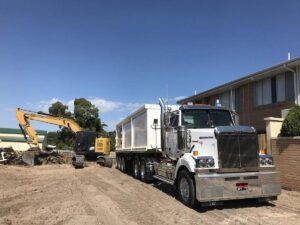
What do you need the site to be ready for after demolition? That question helps shape a practical scope for demolition and site clearing melbourne projects. Access, nearby properties and the condition you need at handover all affect how the work should be planned.
Before machinery arrives, get clear on what the work includes, how the stages fit together and what needs to be agreed about site access. This guide covers the main planning stages, scope decisions and practical considerations for preparing a Melbourne site for its next use.
Diamond Earthmovers is a Melbourne-based, family-owned Victorian business providing demolition and excavation as part of its earthmoving services. These stages can be planned together when excavation follows demolition and clearing.
Key Takeaways
- Demolition and site clearing melbourne projects can range from removing part of a structure to preparing a wider area for its next use.
- Agree on the work area, access arrangements and handover condition so the scope reflects what the next project stage needs.
- Site boundaries, nearby properties and available space can shape how the work is staged.
- A practical sequence moves from defining the scope and assessing site conditions to completing the work and reviewing the handover.
- Diamond Earthmovers is a Melbourne-based, family-owned Victorian business providing demolition and excavation. View Diamond Earthmovers on Google Maps.
What demolition and site clearing in Melbourne can include
A clear scope spells out what will be removed, which areas are included and the condition the site should be in at handover. For demolition and site clearing melbourne projects, these details connect the work to both the existing site and its intended next use.
Demolition removes a structure or an agreed part of one; site clearing prepares the affected area for its intended next use. Demolition might involve taking down a whole building or a defined section. Site clearing focuses on preparing the agreed area after, or alongside, demolition. The tasks depend on the scope, so don’t assume debris removal or other work is included unless it forms part of the agreed handover. Specialist property maintenance operators like JBM Custom Contracting highlight how junk and debris removal is often scoped as a dedicated service rather than being bundled in automatically.
Demolition, clearing and excavation have different purposes. Excavation involves working with the ground, such as digging or shaping it for a later stage. It may follow demolition and clearing, but it should be scoped separately. For a general overview of Demolition processes and methods, see Wikipedia.
What work belongs in a demolition and site clearing scope?
Identify the structure or parts to be demolished, the area to be cleared and the boundaries of the work. Describe the expected handover condition too, so everyone has the same understanding of what the site should look like when the agreed work is complete.
Before work starts, consider:
- Which structures or sections are included?
- What areas are inside the clearing boundary?
- What condition does the next project stage require?
- Which tasks are included in the agreed handover?
Specific answers make the scope easier to follow and reduce assumptions about what the work covers.
How does site clearing connect with excavation?
Clearing may come before excavation, but the sequence depends on the site and what needs to happen next. If excavation is part of the project, the required ground preparation can affect what should be removed, which areas need to remain accessible and how the handover is defined. Diamond Earthmovers provides both demolition and excavation, so the stages can be planned around the project sequence.
For more on the next stage, read the Professional Excavation Melbourne guide. You can also view Diamond Earthmovers on Google Maps.
How demolition and site clearing projects are planned and carried out
A well-planned demolition and site clearing melbourne project moves through clear stages, from agreeing the scope to reviewing the handover. The sequence below is a useful guide, while the methods and timing depend on the site and work involved. Project approvals and other requirements can vary, so establish what applies before scheduling the work.
What should be assessed before demolition starts?
Start with the structure and exact work area, then consider what surrounds it. In Melbourne, access may be affected by a narrow driveway, limited staging space, a busy street or neighbouring homes and businesses. The intended next use matters too, as it helps define what needs to be completed before the site moves to its next stage.
How does the work move from demolition to site handover?
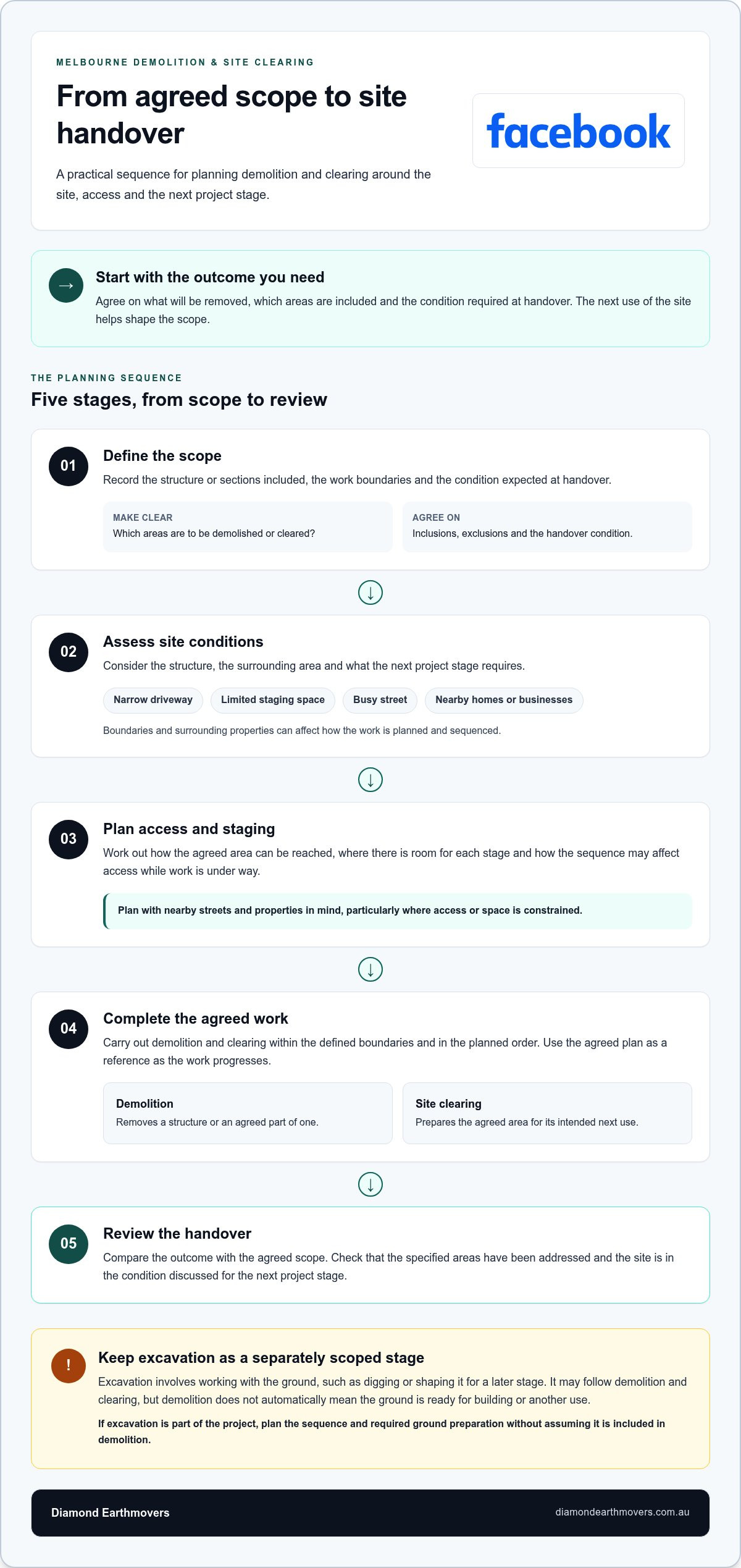
Once the site and scope are understood, use this sequence to keep planning and communication clear:
- Define the scope. Record which structure or areas are included, the work boundaries and the condition expected at handover. Clear inclusions and exclusions help prevent different assumptions about what the job covers.
- Assess site conditions. Consider the structure, surrounding area, access constraints and intended next use. For example, a site beside occupied properties may need careful planning around boundaries and work sequencing.
- Plan access and staging. Work out how the agreed area can be reached and where there is room to carry out each stage. Consider nearby streets and properties, and how the sequence may affect access while work is under way.
- Complete the agreed work. Carry out demolition and clearing within the defined boundaries and in the planned order. The agreed plan provides a practical reference as the work progresses.
- Review the handover. Compare the outcome with the agreed scope. Check that the specified areas have been addressed and that the site is in the condition discussed for the next project stage.
Demolition doesn’t automatically mean the ground is ready for building or another use. If excavation is part of the project, it may follow clearing as a separate stage, planned around the required ground preparation. Defining the sequence helps coordinate the transition without assuming excavation or a particular finish is included in demolition.
For a project-specific scope, discuss your demolition and site clearing project with Diamond Earthmovers.
How to define the right demolition and site clearing scope
The right scope starts with the outcome you need, not simply the amount of material to remove. For demolition and site clearing melbourne projects, consider which parts of the site need to change, how people and equipment will access the work area, and what the next project stage requires.
Demolition doesn’t automatically leave a site ready to build. Removing a structure and preparing the ground for construction are different tasks. Include any specific finish or material removal in the agreed scope rather than assuming it comes with demolition.
When might a project need demolition only or broader site clearing?
If only one section of a structure needs to be removed while other areas remain, partial demolition may suit the intended outcome. If the whole structure is to come down, the scope can focus on full structure removal. Where the project also needs a wider area prepared, site clearing may extend beyond the building footprint. Define the work around what you plan to do next.
| Scope option | Work area | Next-stage need | Access consideration | Agreed handover condition |
|---|---|---|---|---|
| Partial demolition | A defined section of a structure | Retain other areas for continued use or later work | Plan access around the parts that remain | Specify which sections are removed and what remains |
| Full structure removal | The agreed structure or building | Make way for a replacement or a different use | Consider entry to and movement within the work area | State what removal work is included and what condition is expected |
| Broader site clearing | The structure and other agreed areas | Prepare a larger part of the site for its next stage | Consider access across the wider work zone | Define the boundaries and any materials or features to remain |
What does a clear site handover mean?
“Clear” needs a practical definition for your project. Agree on the exact boundaries, what materials or features will remain, and whether the next stage needs excavation or another form of ground preparation. A site intended for excavation may need a different handover from an area where the work is limited to removing a particular structure.
Put the expected condition in the scope rather than relying on assumptions about what demolition usually includes. If excavation follows, the Professional Excavation Melbourne guide can help you understand that next stage. Diamond Earthmovers can coordinate demolition and excavation around your project’s sequence. Discuss your demolition and site clearing scope with the team.
Planning a Melbourne demolition project around access and site conditions
Access and site conditions can shape how demolition work is staged, which areas can be reached and how the project connects with its next phase. For demolition and site clearing melbourne projects, consider these details early, particularly where the work area is close to neighbouring properties or a street.
What site conditions can affect demolition planning?
Look at the structure, the work area boundaries and the space around it. A narrow driveway, limited room to stage work, nearby buildings or the position of the structure may affect the order of tasks and the practical approach. On challenging terrain or narrow footprints, specialised tracked machinery from providers like Ayr Tracked Plant & Equipment Hire shows how compact equipment can navigate restricted areas effectively. Ground conditions can also matter, particularly if excavation is part of the project sequence. Consider these factors together rather than in isolation.
How can you prepare the site for a clear project sequence?
Before work begins, identify what’s included, what needs to remain undisturbed and what the site is intended for next. This gives the project team a useful reference when planning access and staging. A simple site plan or marked-up photograph can show boundaries, entry points and nearby features to consider.
Use this checklist to prepare for a project discussion:
- Access: Note the entry route, any narrow points and where movement may need to be coordinated.
- Work boundaries: Mark the structure or area involved and identify adjacent parts of the property that are to remain.
- Nearby properties and streets: Consider what sits close to the work area and how activity or access may affect the surrounding space.
- Staging space: Identify where there may be room to carry out the planned work without blocking essential access.
- Next stage: State whether the site will need excavation or another form of preparation after demolition and clearing.
Thinking through access before work starts helps clarify the sequence. Where space is limited, for example, the order of work may need to account for how the site remains accessible as each stage is completed. If the project also involves access works, Diamond Earthmovers can plan demolition and excavation around the site and intended outcome.
As a Melbourne-based, family-owned Victorian business, Diamond Earthmovers coordinates work around project requirements. Clear communication about boundaries, access and the next stage helps keep the scope focused on what the site needs.
Demolition and site clearing with Diamond Earthmovers
Diamond Earthmovers is a Melbourne-based, family-owned Victorian business providing demolition and excavation for residential and commercial projects across Victoria. The Diamond family takes a practical approach to planning work around the site, agreed scope and intended next stage.
For demolition and site clearing melbourne projects, the work needs to fit together rather than treating each task in isolation. If excavation follows demolition and clearing, both stages can be considered as part of the site preparation sequence. The agreed scope reflects the work needed for the project and the handover condition required.
What can Diamond Earthmovers help prepare?
Diamond Earthmovers undertakes demolition and general excavation for residential and commercial sites. A project might involve removing a structure or agreed section, preparing the affected area, then carrying out excavation where it forms part of the next stage. Broader earthmoving work can also support a site’s intended use, such as preparing access roads for a project.
Each site has its own constraints. The team considers the work area, access and sequence so the agreed scope suits the property and the outcome you’re working towards. View Diamond Earthmovers on Google Maps.
What information helps start a project conversation?
Share the Melbourne project location, whether it’s residential or commercial, the structure or area involved, and what you intend to do with the site next. It’s also helpful to describe access constraints, nearby properties and any areas that need to remain untouched.
If excavation follows demolition, mention that too. It helps define the sequence and the site condition needed for the next stage. You don’t need to have every detail finalised before starting a conversation; a clear outline of your goals and known site conditions is a useful place to begin.
Set your site up for the next stage
A successful demolition and site clearing melbourne project starts with a clear outcome. Define the structures and areas included, consider access and nearby properties, and agree on the handover condition before work begins. Demolition doesn’t automatically prepare the ground for building, so include excavation in the plan if it’s part of the next stage.
Diamond Earthmovers is a Melbourne-based, family-owned and operated business providing demolition and excavation services across Victoria. The team tailors the work and sequence to your site and intended use, helping you move from an agreed scope towards the next project stage.
When you’re ready to discuss your project, share the location, work area, access considerations and what you’re planning next.
Discuss your demolition and site clearing project
Frequently Asked Questions
Is demolition the same as site clearing?
No. Demolition means removing a structure or an agreed part of one, while site clearing prepares a defined area for its next use. Your project may need demolition, clearing or both, depending on the site and what happens next. Set out the work boundaries and expected handover condition in the scope, so everyone understands which areas are included and what the completed work should achieve.
What does demolition and site clearing include?
The work depends on the agreed project scope. It may cover removing a structure, clearing a defined area or coordinating demolition and clearing with excavation. Don’t assume every project includes the same tasks or leaves the site in the same condition. Before work proceeds, clarify the boundaries, access arrangements, intended site use and any follow-on earthworks, so the scope reflects the outcome your project needs.
Do I need site clearing after demolition?
Not always. Some projects require demolition only, while others need additional clearing or excavation before the next stage. The right scope depends on what remains in the agreed work area and what the site needs to support next. Demolition alone doesn’t automatically make every block ready to build on. Describe the handover condition you need rather than relying on assumptions about what “cleared” means.
How is a demolition and site clearing project planned in Melbourne?
Planning starts by defining the work area, intended outcome and available site access. The sequence can then account for nearby properties, staging space and any excavation that follows. Melbourne sites differ, so one approach won’t suit every project. Diamond Earthmovers tailors demolition and excavation work to the site and agreed scope, helping coordinate the stages around what needs to happen next.
Can demolition and excavation be completed as part of one project?
Yes. Diamond Earthmovers provides both demolition and excavation, and the work can be coordinated when both are included in the project scope. The sequence depends on the site and what the next stage requires. Planning these activities together helps clarify the handover between them. State how excavation fits into your plans when defining the demolition scope.
What information should I provide for a demolition enquiry?
Share the project location, the structure or area involved, the site’s intended next use and any known access constraints. Include whether excavation or broader site preparation may follow, as well as areas that need to remain untouched. These details help shape a useful project conversation for Melbourne and Victorian sites. View Diamond Earthmovers on Google Maps, or discuss your demolition and site clearing project.